

PoE – Power over Ethernet
Or in Danish: Power supply via the network cable.
A traditional network installation most often consists of several smaller network devices, e.g. Ethernet switches, data collectors, routers, access points, IP cameras, etc. Each device requires a power supply, often from a 230V adapter that is specific to each unit.
Today, many products with a network connection (RJ45) support PoE.
The devices that deliver PoE to other devices, such as network switches and PoE injectors, are called PSE (Power Sourcing Equipment).
The devices that are powered via PoE are referred to as PD devices (Powered Devices).
PoE is divided into several power classes (IEEE802.3af/at/bt), referred to as PoE, PoE+, PoE++, PoE Ultra, and they can deliver power per RJ45 port from 14.4 watts up to 99 watts.
It is important to check what the manufacturer specifies as the maximum total power – the PoE budget. For example, it may be 480 watts, and if it is a 24-port PoE switch, this means that each RJ45 port can deliver a maximum of 20 watts if all ports are equally loaded. Not all PoE ports are loaded equally, so the switch can safely deliver sufficient power to all connected devices while staying within its PoE budget.
The PoE switch automatically sets the maximum power per RJ45 port, depending on the power requirement of the connected PD device.
The PoE switch monitors each RJ45 port and can shut off the PoE voltage if the power exceeds the allocated limit. The other RJ45 ports are not affected.
PoE voltage is between 48VDC and 57VDC.
The chicken and the egg – what makes a PoE PSE device apply voltage to an individual RJ45 PoE port?
Not all devices with a network port can tolerate 48VDC on the RJ45 port. Therefore, a PoE switch / PoE injector has a very simple built-in check, although it is unknown to many.
The PoE switch / PoE injector measures whether the PoE PD (receiver) has a built-in resistance between 19–26.5 kOhm on the network port.
Only if this is the case will the PoE PSE apply 48VDC PoE voltage to the PD device.
When the PD device has booted up, they exchange requirement data, etc.
The PoE voltage is transmitted through wire pairs, even though they are simultaneously used for data transmission. Alternatively, unused wire pairs can transmit the PoE voltage.
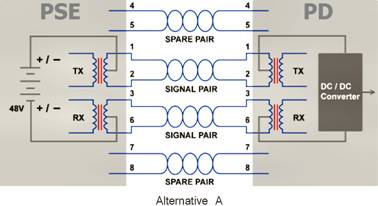

End-span uses pins 1, 2 for +48V and pins 3, 6 for minus
Mid-span uses pins 4, 5 for +48V and pins 7, 8 for minus
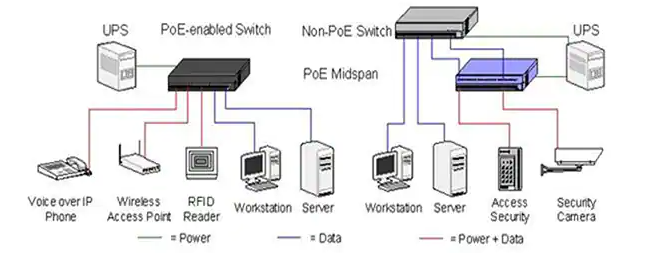
End-span PoE PSE sends voltage directly to the PD devices. End-span uses either spare pairs or data pairs in the cable, which are also used for Gigabit transmissions. End-span requires PoE-enabled switches.
Mid-span uses an injector that is placed between an existing Ethernet switch and the PDs. The mid-span system is typically placed next to the switch and is regarded as PSE, which makes it possible to route the cable uninterrupted to external devices.
Mid-span may only use the extra pairs in the cable and therefore cannot be used to transmit power over data lines for Gigabit Ethernet connections.
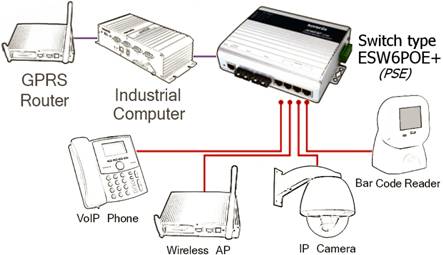
The diagram below shows a typical example of the use of PoE, where an Ethernet switch with PSE functionality is connected to a number of devices with PD functionality.
The range of PoE-compatible products is very large today, but there are many PoE PD devices that have “borrowed” the PoE name, even though they are categorized as “Passive PoE”. These are NOT compliant with PoE standards, but are merely a simple power supply.
Passive PD devices must be supplied with a DC voltage such as 5, 12, 24, or 48VDC. There are “PoE PSE” injectors that support Passive PoE. Caution is required here, as they can damage network equipment that is not designed for PoE.
The idea of supplying power through the network cable is good, but it also requires the use of good network cables (avoid “paper cables” – buy quality cables from DANBIT).
Pros and cons of PoE
Advantages:
Time and costs
PoE can reduce time and costs by avoiding the installation of electrical cables. Network cables do not require a qualified electrician to install.
Reducing the number of required power outlets per installed device saves money. It also reduces energy costs by allowing centralized control of power consumption.
Flexibility
Without being tied to power outlets, devices such as displays, security cameras, and Wi-Fi can be placed in ideal locations and easily relocated.
Safety
Power delivery using PoE is designed to intelligently protect network equipment against overload, undercurrent, and incorrect installation.
It also eliminates the danger of working with or around hazardous high-voltage power sources.
Reliability
PoE power comes from a central and universally compatible source rather than a collection of distributed power adapters.
It can be connected to an uninterruptible power supply (UPS), enabling continuous operation even during power outages.
PoE also allows devices to be easily disabled or reset from a centralized controller.
Scalability
Having power available on the network means that installation and distribution of network connections is simple and efficient.
Disadvantage:
If the PoE switch fails, all devices will lose power. A broken data connection will occur if a standard switch is defective.
Use good network cables – you can buy them from DANBIT. They cost a little more, but you avoid downtime.